
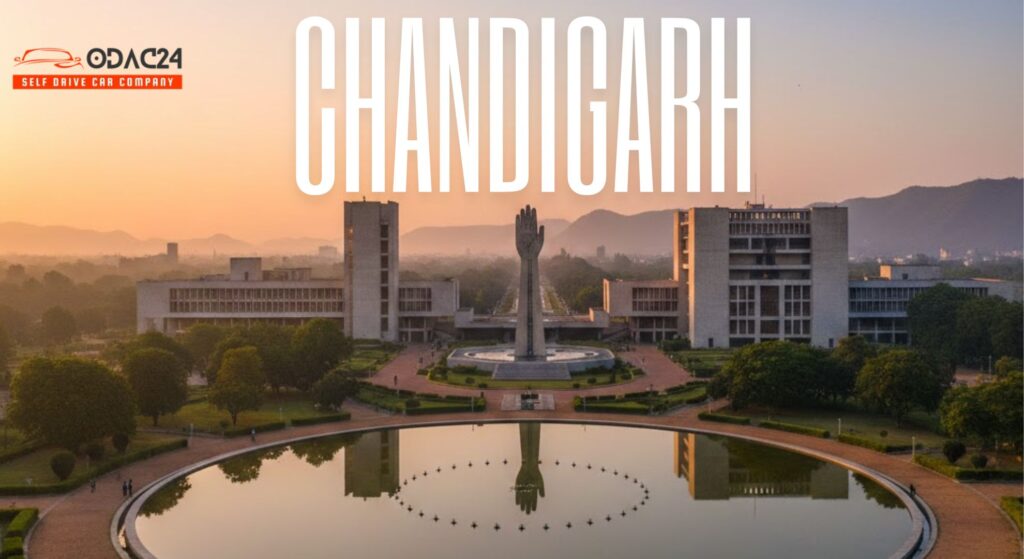
Chandigarh, the union territory at the foothills of the Shivalik Himalayas in northwestern India, is often celebrated as a “City Beautiful”. Conceived after India’s 1947 partition, it was envisioned by Prime Minister Jawaharlal Nehru as a modern capital for East Punjab. The city was laid out in 1952–53 and planned by architect Le Corbusier. Its name comes from the nearby Chandi Mandir (a temple to the goddess Chandi) and a fort (“garh”) beyond it, hence Chandigarh meaning “fort of Chandi”. Nehru hailed Chandigarh as a landmark of urban planning, and indeed today it ranks very high in human development and quality of life in India. It uniquely serves as the shared capital of both Punjab and Haryana, even while itself being a separate Union Territory under central administration.
This blog written by ODAC24 (Self Drive Cars in Chandigarh ) Expert Team
Chandigarh covers about 114 sq. km and (as of 2011) had a population of ~1.055 million. Its master plan, often described as an “anthropomorphic” city, treats the Capitol Complex (Sector 1) as the “head” and the commercial heart (Sector 17) as the “heart”, with green belts as the “lungs”. The city is organized into numbered sectors, each self-contained, and connected by wide boulevards. This rigorous planning and the abundance of parks and gardens make Chandigarh exceptionally clean, green and pedestrian-friendly. It consistently ranks #1 in India for Human Development Index and quality of life.
Places to Visit in Chandigarh
Chandigarh is rich in visitor attractions, blending art, nature and modern architecture:
- Rock Garden (Nek Chand’s Garden): A quirky sculpture park spanning 40 acres, entirely made of recycled industrial and household waste. Started clandestinely in 1957 by public official Nek Chand Saini, it now contains over 5,000 mosaic sculptures of dancers, animals and more, all built from glass bangles, tiles, and broken pottery. It’s a must-see artistic oasis in Sector 1, adjacent to Sukhna Lake.
- Sukhna Lake: A 3 km² man-made reservoir at the city’s edge. Damming a seasonal stream (the Sukhna Choe) in 1958 created this calm lake, nestled beneath the Himalayas. The dam’s promenade is a popular spot for evening strolls, boating and birdwatching. Motorboats are banned (as insisted by Le Corbusier), preserving its serene atmosphere. The lake and its waterfront parks often host festivals (like the annual Mango Festival) and sports events.
- Zakir Hussain Rose Garden: Asia’s largest rose garden, covering 30 acres in Sector 16. Established in 1967 and named after President Zakir Husain, it boasts 50,000 rose bushes of over 1,600 varieties. In spring (Dec–Feb), a Rose Festival draws thousands. The garden also includes medicinal plants and a bonsai collection.
- Capitol Complex (Sector 1): A UNESCO World Heritage site, this is Chandigarh’s administrative core. Designed by Le Corbusier, it comprises three iconic concrete buildings – the Legislative Assembly, the Secretariat and the High Court – plus public monuments (Open Hand, Tower of Shadows, Geometric Hill) and plazas. The Open Hand Monument – a 27-foot sculpture of an open palm – embodies the city’s motto “open to give, open to receive.” Tours of the Capitol Complex reveal Chandigarh’s modernist architectural heritage.
- Sector 17 Plaza (City Centre): The commercial and cultural “heart” of Chandigarh. Sector 17 is a broad, pedestrianized boulevard filled with fountains, shops, banks, and cafes. The four-story concrete buildings (painted white) house offices and showrooms, while malls and markets fill the plazas. It’s the city’s main shopping and nightlife hub. Key attractions here include the Inter-State Bus Terminal (IBS), Neelam and Himachal Piazza (fountains and light shows), and the centrally located District Court and government offices. Sector 17’s open design and wide pavements encourage evening strolls and social gatherings.
- Other Notables: Chandigarh boasts many more attractions, including the Japanese Garden (Sector 31), Leisure Valley (a long linear park stretching across sectors), and the Himalayan Outskirts: the foothills around the city are a launching point for trips to Shimla (≈104 km away) or Manali. Nearby government-run gardens like the Botanical Garden and Cactus Garden are also worth a visit. In short, Chandigarh’s blend of modernity and greenery makes it ideal for tourists.
Food & Lifestyle in Chandigarh
Chandigarh offers robust Punjabi cuisine, lively street food and a growing café culture:
- Punjabi Delights: Local specialties include tandoori delights (butter chicken, tandoori chicken), rich curries (dal makhani, chana masala, sarson ka saag) and traditional breads (naan, makki di roti). Famous regional treats – amritsari kulcha (stuffed bread) and bedmi poori (spicy lentil poori) – are widely available at breakfast points. Sweet shops brim with mithai (e.g. kaju barfi at Sindhi Sweets, Sector 17).
- Street Food: Sector 7, 26 and 34 markets are known for mom-and-pop dhabas and stalls. Popular quick bites include kachori–samosas, dahi bhalla and golgappa. In winter, steaming kir (hot buttermilk) and ghinger tea stalls pack the outdoor markets.
- Cafés and International Fare: In recent years, many chic cafés and bistros have opened, particularly in sectors 7, 9 and 17. Places like Backpackers Café (Sector 8) and Virgin Courtyard (Sector 35) serve global dishes and craft coffees. The city also boasts upmarket lounges and clubs (Kitty Su at The Lalit, Tamasha, Peggy’s) for nightlife; many Punjabi youths gather at lakeside restaurants (Sector 28/Punjab University food court) and mall food courts (Elante Mall in Mohali) into the late evening.
- Shopping: Chandigarh offers diverse retail. Beyond Sector 17’s street shops, large malls include Elante Mall (Mohali) and North Country Mall (Sector 36). Sector 17 Plaza and Chandigarh Haat market (Sector 17E) feature handicrafts. For designer boutiques and household goods, SCO (Small Commercial Office) markets in various sectors are popular.
Living in Chandigarh
Many people consider Chandigarh one of the best cities to live in India. It consistently tops surveys for cleanliness, greenery and governance. A compact city with strict planning, Chandigarh has few slums and abundant parks; stringent traffic rules and neighborhood markets in each sector make daily life convenient. It also ranks as India’s wealthiest town per capita, reflecting high incomes and savings.
- Quality of Life: With high HDI and literacy rates, residents enjoy good schools (public and private), top hospitals (PGIMER, General Hospital), and extensive public services. The city’s infrastructure – from roads to power and sanitation is well-maintained.
- Best Areas: Popular residential sectors include Sector 7, Sector 11, Sector 22, Sector 37 and Sector 44, which have a mix of houses and high-rises. Sectors 8, 9 and 17 are more commercial. Sectors 15 and 26 house government offices and the large PGI hospital. (For students, sectors near Panjab University – 14, 15, 25 – have many hostels and PG accommodations.) Land prices and rents in Chandigarh are higher than in many Punjab towns, given its limited space and high demand; however salaries are also higher on average.
- Chandigarh vs Mohali vs Panchkula: The “Chandigarh Capital Region” spans these three cities. Chandigarh is a UT city (governed by a Lieutenant Governor), Mohali (officially SAS Nagar) is a rapidly developing IT and industrial hub in Punjab, and Panchkula is a satellite city in Haryana. Together they form a metropolitan area of about 1.6 million people. In general, Chandigarh offers more government jobs and planned development, while Mohali and Panchkula have expanded rapidly in the private sector and real estate.
- Cost of Living: Chandigarh’s cost of living is moderate by Indian city standards: food and transportation are affordable, though housing can be expensive. Groceries, utilities and schooling are comparable to Delhi or Pune, but rents in prime sectors (e.g. Sector 37/44 flats, or homes in Sector 7/11) are relatively steep. Many students and young professionals stay in paying guest (PG) accommodations in sectors 14–25 or in Mohali, where rents are lower.
Education & Jobs
Chandigarh is a major educational center. Key institutions include:
- Panjab University (Sector 14): One of India’s oldest universities (est. 1882), PU’s Chandigarh campus houses numerous departments in arts, science, engineering and management.
- Punjab Engineering College (Sector 12): A premier engineering college (now a deemed university) known for its B.Tech and M.Tech programs.
- Chandigarh University (CU, Mohali): A private university established in 2012. CU has rapidly gained prominence – it is ranked among India’s top private universities (QS World University 2026 rank ~575 globally, QS Asia #1 among private universities) – offering hundreds of courses in engineering, management, pharmacy and more. (Note: Chandigarh University is in Mohali, Punjab, not to be confused with government Panjab University.)
- Other colleges: Regional Engineering College (now NIT, Chandigarh), Government College of Art, Architecture College (Sector 12), and the highly reputed Postgraduate Institute of Medical Education & Research (PGIMER) offer advanced courses. There are also many coaching institutes (for IIT-JEE, NEET, civil services, etc.) concentrated in sectors like 9 and 32.
Job opportunities: Being an administrative capital, many Union and state government jobs (in bureaucracy, banks, railways, PSUs) are based here. The software and IT sector is growing – Chandigarh (and Mohali) have IT parks (e.g. Rajiv Gandhi Chandigarh Technology Park) employing thousands of IT professionals. According to the administration, the city is an emerging hub for IT, services and biotechnology. Chandigarh’s highest monthly salaries tend to come from central government postings and multinational companies in Mohali; Punjab government and education roles also hire many graduates.
Travel & Transport
Chandigarh is well-connected:
- By Air: The Shaheed Bhagat Singh International Airport (IATA: IXC) in Mohali (about 13 km from Sector 17) is Chandigarh’s airport. It handles flights to all major Indian cities (Delhi, Mumbai, Kolkata, Chennai, Bangalore, etc.) and some international flights (Dubai, Sharjah). Frequent shuttle buses and cabs link the airport to the city.
- By Train: Chandigarh Junction (CDG) is the main railway station, located in Industrial Area-1 (east of the city center). It’s about 8 km from Sector 17. The station has direct trains to Delhi, Mumbai, Kolkata, Chennai, and many regional destinations. The modern terminal and high footfall (daily thousands of passengers) make it a convenient gateway.
- By Road: Chandigarh lies on National Highways connecting it to Delhi (~250 km, 4–5 hours by car or bus), Amritsar (~235 km), Shimla (~100 km) and beyond. Frequent government and private buses run to nearby cities like Delhi, Ambala, Ludhiana and Chandigarh Municipal Transport buses cover intercity routes. Inside the city, auto-rickshaws, taxis (including app-based cabs) and a city bus system (CTU buses) provide local transit. Notably, Chandigarh was among the first Indian cities with dedicated cycle tracks in each sector, reflecting its planning focus on pedestrians and cyclists.
- Hillside Getaways: Chandigarh is often the starting point for Himalayan trips. Shimla, Himachal Pradesh’s capital, is ~104 km away northwest. Manali, another hill station, is about 8–9 hours’ drive to the north. Tourist operators in Chandigarh offer packages for Shimla, Manali, Dharamshala and the Punjab countryside.
- Best Time to Visit: The ideal season is October to March, when the weather is cool and pleasant. Winters (Dec–Feb) are mild (5–20°C) and ideal for sightseeing. The city’s famous parks bloom in late winter and early spring. Summers (April–June) can be hot (up to 40°C), so sightseeing is harder. Monsoon (July–Sept) brings heavy rain and occasional flooding of Sukhna Lake’s streams, so it’s less popular with tourists.
Environment & Smart City
Chandigarh’s founders intended it as a “green city”, and it retains that character. The Leisure Valley – a long, linear park through the city – plus sector parks (each sector has a green belt) keep air fresh. Iconic gardens (Rock Garden, Rose Garden, Botanical, Japanese Garden etc.) and tree-lined boulevards make it one of India’s most verdant cities. The city’s cleanliness is frequently noted: local regulations and regular community clean-up drives help Chandigarh remain litter-free.
As a declared Smart City, Chandigarh has introduced many tech-driven upgrades. Public spaces feature LED street lighting, Wi-Fi in parks, and electronic noticeboards. The city is expanding its fleet of electric vehicles – even e-buses for public transport – and supports cycling as a pollution-free commute. Underground parking in commercial sectors, app-based citizen services, modernized marketplaces and well-maintained public toilets all reflect ongoing smart-city investment.
Local & Trending
Recent news and trends often focus on Chandigarh’s development. Key points include:
- Real Estate: Land in Chandigarh is at a premium (limited area), so prices are high. There is steady growth in luxury housing and redevelopment of older sectors. Projects in neighboring Mohali/Panchkula (like new townships) also affect Chandigarh’s market.
- Infrastructure Projects: The Chandigarh administration has launched projects like the Rajiv Gandhi Chandigarh Technology Park (for more IT jobs) and is planning skywalks/metro connectivity to reduce traffic congestion.
- Governance: Chandigarh is administered by a UT Administrator (a senior IAS officer). Local governance issues (like issuing building permits, preserving green belts, or cleanliness drives) often make news. Citizen-friendly measures like e-governance portals and mobile apps have been introduced under the Smart City program.
- Education Hub: Panjab University and PGI continue to invest in new facilities. Chandigarh University (Mohali) recently climbed in global rankings.
- Upcoming Attractions: New parks and cultural centers (e.g. archives, museums) are being planned to boost tourism and city culture.
❓ Frequently Asked Questions
- Q: Where is Chandigarh located?
A: Chandigarh is in northwestern India, at the base of the Shivalik Himalayas, on the border of Punjab and Haryana. It serves as the capital of both Punjab and Haryana but is itself a Union Territory under central administration. The Chandigarh metro area includes the nearby cities of Mohali (Punjab) and Panchkula (Haryana). - Q: Why is Chandigarh called the “City Beautiful”?
A: Chandigarh’s nickname comes from its planned greenery and architectural design. Its layout emphasizes open spaces, parks and aesthetics. The official motto given in the 1950s was “Chandigarh – The City Beautiful”. This reflects both the origin of its name (from the Chandi temple and fort) and its intention as a model of modern urban beauty. - Q: Who designed Chandigarh, and who inaugurated it?
A: The city’s master plan and major architecture were devised by Swiss-French architect Le Corbusier. It was inaugurated on 7 October 1953 in a ceremony presided over by President Rajendra Prasad. (Jawaharlal Nehru had earlier laid the foundation stone in 1952, and after partition Punjabi engineers studied other planned cities in Europe before inviting Le Corbusier.) - Q: What is Sector 17 Chandigarh?
A: Sector 17 is Chandigarh’s city center and main shopping-plaza. It’s a pedestrian zone with fountains, plazas and four-story commercial buildings. Sector 17 houses major businesses, banks, restaurants and entertainment. It also contains the main bus terminal and the District Court. It’s often called the “heart of Chandigarh”. - Q: What is Sector 15 Chandigarh?
A: Sector 15 is a primarily residential and administrative sector. It contains some government offices (the UT Secretariat is nearby in Sector 17) and parts of the PGIMER hospital and medical college. Many faculty houses for PGI are in Sector 15. It’s quieter and has several small markets for daily needs. - Q: What happened at Chandigarh University?
A: Chandigarh University (CU) is a private university located in Mohali (Punjab), just outside Chandigarh. It has been climbing in rankings – for example, QS World University gave it a global rank of ~575 in 2026. CU offers many engineering, management and science programs. In recent years, CU has been noted for high placement packages (up to INR 1.7 crore) and being ranked among India’s top private universities. (Note: Chandigarh University is separate from Panjab University, which is a government university in Chandigarh.) - Q: What is Chandigarh’s capital?
A: Chandigarh itself is the capital – for Punjab and Haryana. Since it is a single city/Union Territory, it does not have a capital of its own. The UT’s administrative head is an appointed Administrator. Essentially, Chandigarh is the capital city serving both states. - Q: How far is Chandigarh Railway Station from Sector 17?
A: Chandigarh Junction (CDG) railway station is about 8 km from the city center (Sector 17). It’s located east of the city in Industrial Area-1. - Q: What are the best sectors to live in Chandigarh?
A: Residential sectors like 7, 11, 22, 37, 44 are popular for families. They combine homes/flats with schools and green spaces. Sectors 9 and 17 are busy commercial areas (hotels, shops). Sector 15 is near PGIMER, and Sectors 14–16 border the university campus. Each sector has its own market so most areas are self-sufficient. - Q: How do I reach Chandigarh?
A: By air, fly into Chandigarh Airport (IXC) in Mohali; frequent flights connect to Delhi, Mumbai, Bengaluru, etc.. By train, Chandigarh Junction has direct services nationwide. By road, Chandigarh is on NH-5/NH-7; it’s about 250 km (4–5 hours) north of Delhi and 235 km east of Amritsar. Frequent intercity buses run from nearby cities. Once in town, auto-rickshaws and taxis (including app cabs) are plentiful. - Q: When is the best time to visit Chandigarh?
A: The weather is most pleasant from October to early March. Summers are hot (April–July), and monsoon rains can be heavy (July–September). In winter, the parks are green and the air crisp, making it ideal for sightseeing.